Live Model-Making Classes

Personalized Model Feedback

Mock Situation Tests
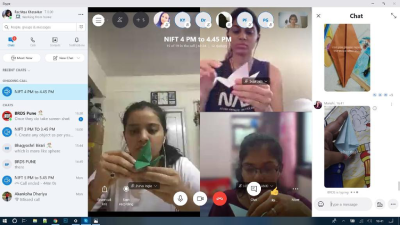

India's No. 1 NIFT Situation Test Coaching
India's No. 1 NIFT Situation Test Coaching


Real Situation Test workshops at BRDS centres
BRDS is proud to announce that BRDS has the highest selection of students in NID NIFT IIT-UCEED / CEED NATA CEPT this year as compared to any coaching institute in India.
Avail Rs. 1 Crore prize money if you prove that any other coaching Institute has more results than BRDS.


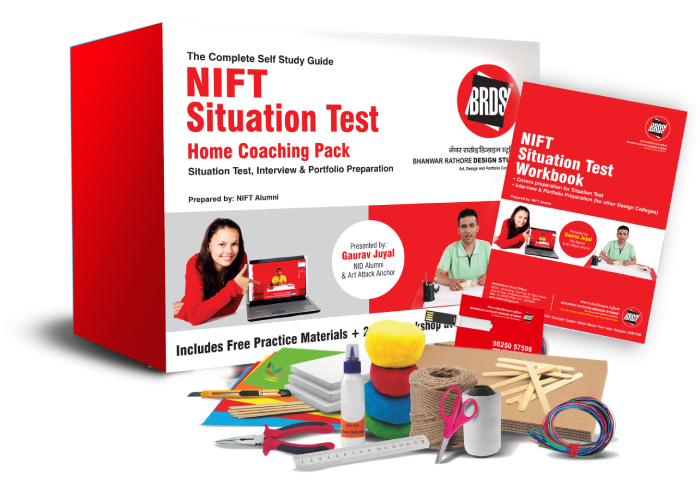
Printed workbook, 19 years of original papers with solutions, 100+ material-handling video lessons, and a 20-piece material kit — exactly what's provided in the real test, delivered to your door.
The NIFT Situation Test is Stage 2 of the NIFT Entrance Examination for B.Des aspirants — the final qualifying round after candidates clear the written Stage 1 (CAT + GAT). NIFT typically calls around three candidates for every available B.Des seat to this round, making it a genuine filter rather than a formality.
In the test, candidates are given a problem statement and a limited set of materials, and must build a three-dimensional model within two hours, then write a short note explaining the concept. Examiners score material manipulation, originality, aesthetic appeal, neatness, conceptualisation and working methodology.
The Situation Test carries 20% weightage in the final NIFT merit score for B.Des candidates. M.Des, MFM and M.FTech applicants don't sit for this round — they instead face a Group Discussion and Personal Interview, which carries 30% weightage. Practice with a familiar, limited material set and steady time management are what separate a strong Situation Test from a rushed one.
The exact date shifts each year with NIFT's own calendar — check nift.ntaonline.in for the official schedule once Stage 1 results are out. Here's how BRDS coaching lines up around it.
| Event | Typical Timing |
|---|---|
| Stage 1 Result (CAT + GAT) | Determines Situation Test eligibility |
| NIFT Situation Test | Usually May – June, shortly after Stage 1 results |
| 5-Day Free Workshop | New batches every 7–10 days once results are out |
| 10-Day Intensive | Enrol as soon as Stage 1 result is announced |
| NIFT PI (M.Des / MFM / M.FTech) | Usually May, at the NIFT Delhi campus |
| Counselling / Final Admission | After combined Stage 1 + Stage 2 merit is released |
Seats fill fast — each Situation Test batch is capped at 20 students (minimum 5 to run), on a first-come basis.
The Situation Test is Stage 2 for B.Des candidates who've cleared the written CAT + GAT exam. Here's exactly how the two hours break down and what's being scored.
NIFT supplies all materials at the centre — candidates aren't permitted to bring their own. Students who clear the Situation Test consistently rehearse with a short, familiar kit close to what's actually provided. Most coaching checklists run far longer than they need to.
Fewer, familiar materials mean less panic and more time spent on concept and construction — exactly what examiners are scoring. Delhi NCR students have it easiest: most of this kit is available off-the-shelf in Sadar Bazaar.
Final NIFT merit combines your Stage 1 written score with your Stage 2 Situation Test (or GD/PI for PG programs) score, declared on the official NTA NIFT portal. Because the Situation Test carries 20% weightage, a strong written rank can still slip if the practical round is under-prepared — which is exactly the round BRDS coaching targets.
BRDS has consistently produced outstanding results in NIFT admissions. With 2,393 students selected in NIFT 2026 — including 85 in the Top 100 — and a total of 16,780 NIFT selections since 2005, BRDS remains India's highest result-producing coaching institute for NIFT. Our Situation Test–specific coaching, expert NIFT alumni faculty, and hands-on material practice have helped thousands of students convert a written pass into a final seat.
It's the final qualifying round for the B.Des program — a practical exam where you build a three-dimensional model from a given theme using limited materials, then write a short explanation of your concept.
Two hours in total, covering reading the brief, sketching, building the model and writing up your concept.
No — NIFT provides all materials at the centre. Personal material isn't permitted, which is why practising with a similar, limited kit at home matters far more than stocking up on supplies.
20% of your final NIFT merit score. A strong written score can still be pulled down by a weak Situation Test, so it's not a round to treat lightly.
No. The Situation Test is the final round for B.Des. The Personal Interview applies only to postgraduate candidates — M.Des, MFM and M.FTech.
Yes — it's a genuine no-cost introduction covering design thinking, one original paper solved live, and open doubt-clearing, at any BRDS centre or on Zoom.
A short, familiar kit beats a long shopping list — mount board, one neutral chart paper, two to three colour sheets, glue, scissors, a marker and thread. Fewer materials mean faster decisions under the two-hour clock.
Every year's result is published — name, photo and city — on the BRDS site, and select years are also carried in newspapers for independent verification. Batches are kept small so faculty can give hands-on feedback on individual models.
Only 20 seats per batch, with a minimum of 5 students to run a batch, so faculty can give individual feedback on every model.
A lot of Situation Test candidates are also sitting NID's own practical round — the DAT Mains Studio Test — where you build and present a model under similarly tight time limits. BRDS runs dedicated NID coaching across 15+ Mumbai centres alongside NIFT Situation Test prep, so the same model-making training carries over.